

Authors: Eng. Giancarlo Belloni and Dr. Manuela Ferrario
Once again, it is that time of year when Halloween returns — along with the flood of images and associations we have come to link to it. For Millennials and younger generations, Halloween is an established celebration. But those who remember the days before it arrived in Italy will recall that, until a few decades ago, this time between October and November was marked only by a day off work and the solemn remembrance of saints and the departed.
Despite its Celtic roots in All Hallows’ Eve—literally, the eve of all saints—and the many European traditions connecting this season with the boundary between the living and the dead, it is clear that the holiday as we know it today, with its grotesque flair and overtly commercial nature, was imported from the United States.
Naturally, Halloween—with its demand for costumes, masks, and spooky decorations—has inspired countless inventors, both professional and amateur. Their creativity has left intriguing traces in patent databases. Using the same analytical tools we employ to help clients explore the innovation landscape in their own technical fields, we decided to take a look. It turns out that nearly 10,000 patent applications mention the word “Halloween” in their description. Unsurprisingly, more than half originate from the U.S., and around 2,000 have actually been granted.
More interesting than the numbers themselves is the content of these patents. As expected, most come from the U.S. Patent and Trademark Office, where we found some true curiosities.
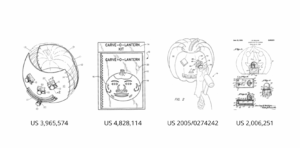
One prolific area involves inventions to simplify the making of the famous Jack-o’-lantern, the carved pumpkin that has become the ultimate Halloween symbol. Many patents concern pumpkin-carving kits—such as U.S. Patents 3,965,574, 4,828,114, and application US 2005/0274242. Another, US 2,006,251 (filed June 25, 1935), describes an electric lighting unit designed specifically for pumpkins.
Curious about the first-ever mention of “Halloween” in a patent, we traced it back to U.S. Patent 1,099,548, granted June 9, 1914. Entitled Pyrotechnic Novelty, it describes an item that burns in a controlled way to produce colored flames. While the patent’s first example is a Christmas log, the inventor notes it can take forms suited to other major holidays—among them Easter, the Fourth of July, Thanksgiving, Valentine’s Day, Washington’s Birthday, and yes, Halloween—with a version shaped like a pumpkin.
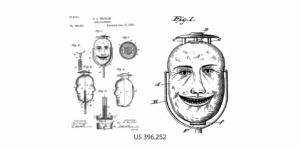
Going even further back, we found U.S. Patent 396,252 (January 15, 1889), which, though it does not use the word “Halloween,” is titled Jack-a-lantern. It details a device for creating illuminated masks, like the one pictured below. If you find the resulting face somewhat eerie, you will be reassured by the inventor George A. Beidler’s words: “This invention relates to certain improvements in that class of devices known as ‘jack-a-lantern’ and it has for its object to provide a new article of manufacture of unique appearance which will form an attractive, desirable and amusing toy for children.”
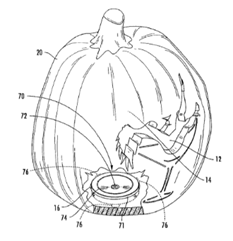
Touched by such thoughtful concern for children, we must nonetheless remember that Halloween is also for adults. Returning to the pumpkin-carving kits, we came across application US 2010/0108561, titled Pumpkin Carving Kit for Carving Sexually Themed Images—a kit for carving suggestive silhouettes of women into pumpkins. Even the handles of the tools, gratuitously, match the theme. The application was never granted.
Finally, the world of trademarks has not escaped the Halloween spirit either. The first U.S. trademark registration for JACK O’LANTERN, filed January 31, 1925, covered canned vegetables. The first to include the word HALLOWEEN (with a pumpkin illustration) was filed November 10, 1934, for citrus and fresh fruit.
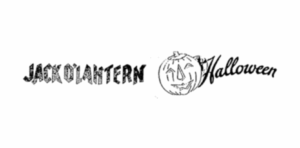
Neither registration has survived—they were both abandoned in the early 2000s—but they remind us how strong a commercial pull holidays have always had.
© THINX Srl – October 2025